

Shalom,
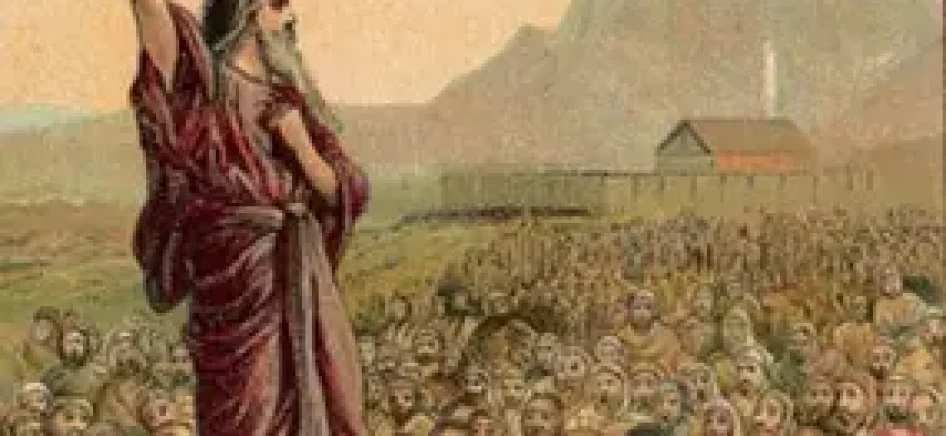
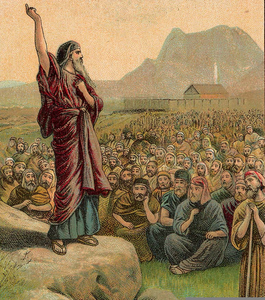
This week’s Torah portion Matot begins with an unusual opening – Moses speaking to tribe leaders without seemingly getting an instruction to do so.
The familiar introduction is lacking. Usually in such cases we have: “and God spoke to Moshe saying…” i: God’s speech is not recorded in the text, rather Moshe speaks. He addresses the tribe leaders ראשי המטות “rashei hamatot“.
The word matot, which is also used to describe the staffs (sticks) used by the tribal leaders, often refers to the tribes themselves:
And Moshe spoke to the chiefs of the tribes of the Children of Israel, saying, “This is the thing which God has commanded.” (Bamidbar 30:2)
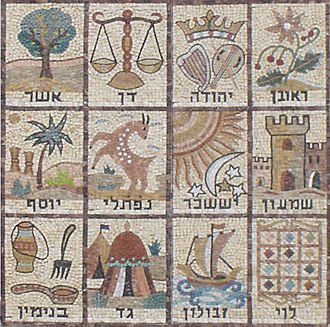
There is a more common Hebrew word for tribe – שבט SHEVET and שבטים SH’VATIM in plural.
Interestingly enough, both MATEH and SHEVET carry two meanings each:
1. Stick/Staff/Rod

2. Tribe
However, since in the original Hebrew language there are no synonyms, there must be some difference between MATEH and SHEVET.
So, it appears that SHEVET is a ruling/dictating stick/rod, while MATEH is a supporting stick.
The subject of Moshe’s speech is vows – the words that compose the vows: man is obligated by the words which he utters.
The words man utters actually create a certain reality. The power of speech is a special virtue mankind received that distinguished it from all other creatures.
And speech is not merely a defining human quality, it is also the manifestation of the Divine breath which resonates within mankind.
It is that special spiritual soul – נשמת חיים NISH’MAT KHAYIM “infused” in us by the Creator that enables us to speak and create by the speech, in a way resembling the Creator, who created the entire universe in ten verses of speech.
The power of words is a major theme in Torah portion Matot.
To address this subject to the tribes of Israel Moses chose a way, which is not dictating, or ruling, but rather that which creates identification with the subject and even leads to a consensus.
This might be the reason for the word MATOT describing the gathering of the tribes of Israel to be chosen for this context, rather than SHVATIM.
The question is: Why should words have such power, power which transcends the realm of mere social contact or obligation?
When God created man, he breathed into him a living soul – described literally as ‘Divine breath‘.
As a result, man becomes a living being:
And the Almighty God formed man of the dust of the ground, and breathed into his nostrils the breath of life; and man became a living soul. (Bereishit 2:7)
It is interesting to note that the commentator Unkolus, deviates from direct translation of the words nefesh chaya – נפש חיה (“living soul”) and translates those as “speaking spirit”.
The entire universe was created by Divine speech:
And God said, ‘Let there be light’; and there was light. (Bereishit 1:3)
When we read that Creator “speaks”, we should interpret this as Creator causing sound to be heard.
When man speaks, he should be aware that he is using a tool which God purposely and specifically chose to use in the very act of creation.
And in the same way that Divine speech and action are the same, when man speaks, he should be extremely fastidious in keeping his word, in an attempt to be as “godly” as he can be.
A very known magic incantation Abracadabra, used by the magicians for their tricks.
There are several speculations as to the origin of this incantation.
One of them could be that Abracadabra consistsof two words originating in Hebrew.
EVRAH KA’DABRAH – אברא כדברה which would mean “I will create as I speak”.
Several commentators point out that the word “neder” נדר (vow) is related to the word “dira” – דירה (dwelling):
Thus, a person who makes a neder is making a home for the Creator.”
By using words, which are themselves a Divine tool, man can bring The Creator into the situation, making him an ally.
HEBREW CORNER
Let’s explore some modern uses of the word MATEH – מטה.
מטה – headquarters, staff
רמטכ”ל – RAMATKAL – Israel Army Chief od Staff
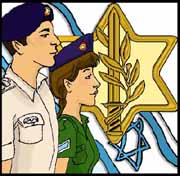
This is actually an acronym
ראש המטה הכללי
Since we are in the tumult of the coming elections in Israel, let’s mention;
מטה המפלגה – MATEH HA’MIFLAGAH – Party Coordinating Office
And relating again to this month of Tamuz let us have good thoughts in our hearts – see the GOOD points in each other, and have GOOD words in our mouth for each other.
Shabbat Shalom
Yoel & Orly
Many ask us for a permission to redistribute our newsletters. By all means, please do feel free to forward this newsletter to anyone you wish!
Access the archive of our previous posts at:
https://www.ulpanor.com/category/blog/
Subscribe to our newsletters on our website at the bottom of the home page:
