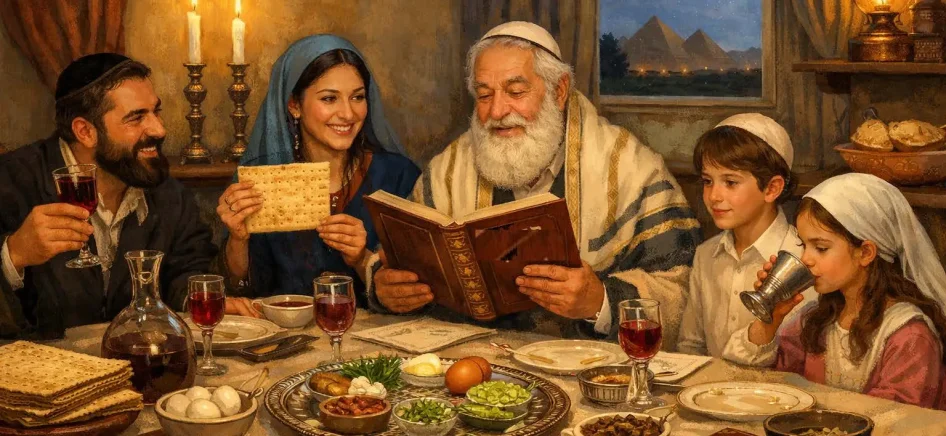
Let’s start with a question: Why is the holiest night of freedom called סֵדֶר / Seder (order)?
Maybe it is because the Torah is teaching us something astonishing:
Freedom is not chaos. Freedom is not “doing whatever I want.” Freedom is not the collapse of structure. Real freedom is built through holy order.
Egypt also had a kind of order: quotas, bricks, schedules, taskmasters, endless pressure. But that was the order of slavery. On Pesach night, we take the word seder and redeem it.
We move, step by step, from oppression to dignity. From silence to speech. From memory to identity. From pain to praise. From being managed by history to becoming the tellers of history.
That is why the night is so carefully structured. Not because Judaism loves ceremony for its own sake, but because the soul often needs a path. The heart does not always leap instantly into freedom. Sometimes it must climb.
And the Seder is exactly that: a ladder of freedom.
וְהִגַּדְתָּ לְבִנְךָ בַּיּוֹם הַהוּא
Ve’higadta levincha bayom ha’huu
“And you shall tell your child on that day.”
(Shemot / Exodus 13:8)
This is not only a command to pass on information. It is a command to become a storyteller again.
Pharaoh turns human beings into producers. The Haggadah turns them back into people with memory, voice, and destiny.
That is why the night begins with questions.
- A slave is told what to think. A free person asks.
- A slave obeys the script of fear. A free person enters the drama of meaning.
And then every symbol becomes one more rung on the ladder:
- The thin Matzah teaches humility. Redemption begins when the ego deflates.

- Maror (bitter herb) teaches honesty. Freedom is fake if it skips over bitterness.

- The four cups teach enlargement. A constricted heart slowly learns abundance.

- Hallel teaches that the end of freedom is not self-expression alone, but gratitude.
- Reclining teaches that redemption must reach even the body. We do not only speak freedom. We sit like free people.

Halacha and Haggadah – Law and Story
Pesach night also joins two worlds that people often separate: Discipline and imagination. Form and fire.
If there is only law, the night can become technical. If there is only inspiration, the night can become vague. But the Seder insists that true transformation needs both: a vessel and a soul, structure and meaning, deed and story.
That is one reason this night remains so powerful even for Jews far from regular observance. Something in the Jewish soul recognizes that this is not just a festive meal. It is identity in motion.
A Chassidic story for Pesach
A Chassidic tale tells of a simple Jew who came to the Seder exhausted, poor, and overwhelmed. He did not know all the commentaries, and he could barely keep up with the learned people around him.
But when they reached “Avadim hayinu / We were slaves,” he began to cry.

Someone asked him, “Why are you crying now?”
He answered, “Because all year I thought Egypt was back then. Tonight I realized that I am still trying to get out.”
That is the greatness of the Seder.
It does not ask only: What happened to our ancestors? It asks: Where is Egypt still inside me? Where am I still trapped in fear, anger, ego, habit, despair, or smallness? And what would it mean to begin walking out?
A contemporary connection
Modern psychology, in its own language, says something surprisingly close to the Haggadah.
Viktor Frankl argued that the human being is driven not only by pleasure or comfort, but by a search for meaning. The Seder understands that instinctively: liberation is not enough unless it becomes meaningful, remembered, and directed toward a higher calling.
Narrative psychology adds another layer. The APA – American Psychological Association notes that the stories people tell shape memory, behavior, and identity, and research has linked coherent autobiographical storytelling with psychological well-being.
That makes the Haggadah profoundly relevant: on the night of freedom, we retell the story until it becomes our story again.
Hebrew Corner: סדר / Seder
A few beautiful modern Hebrew expressions from the root ס־ד־ר:
- לַעֲשׂוֹת סֵדֶר / la’asot seder — to put things in order
Not only in a closet. Also in life. - לֹא בְּסֵדֶר / lo beseder — not okay
In modern Hebrew this means: something is wrong, off, unsettled. - הִסְתַּדַּרְתִּי / histadarti — I managed, I worked it out
A classic Israeli word of resilience. - בְּסֵדֶר גָּמוּר / beseder gamur — perfectly fine
- סֵדֶר בָּרֹאשׁ / seder ba’rosh — mental clarity, inner order
That is the secret of Pesach night: The goal is not control. The goal is inner order that makes freedom possible.
SEDER – A word for this year
This year, that message lands differently. As Israel continues through war with Iran and renewed fire from Lebanon, freedom does not feel abstract. It feels fragile, precious, prayed for.
Families are carrying fear, uncertainty, and national strain even as they prepare for Pesach. In such a season, the Seder becomes more than tradition. It becomes an act of Jewish defiance: we still gather, we still tell the story, we still teach our children, and we still believe that history is not sealed by Pharaoh forever.
Perhaps that is the deepest meaning of Pesach Night of Seder:
Not that everything is already redeemed. But that redemption has an order. A path. A memory. A voice. A table. A family. A people.
And every year, we climb again.
May this Pesach help us leave behind the narrow places within and around us. May it bring strength to Israel, healing to the wounded, comfort to grieving families, and freedom in the deepest sense of the word.
Shabbat Shalom and Pesach Sameach.
Yoel & Orly