


Shalom,
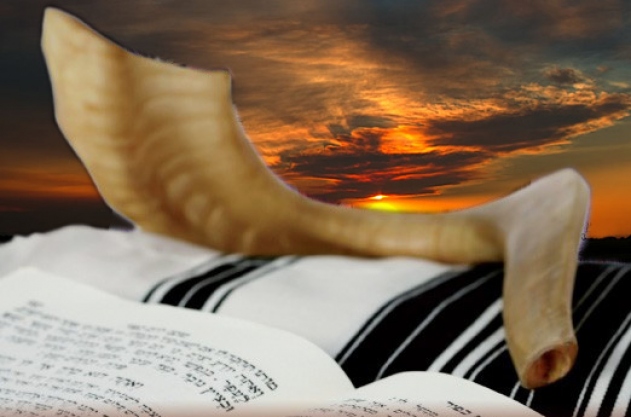
This coming Sunday night we will be celebrating the New Hebrew Year – Rosh Hashanah
ראש השנה
Rosh Hashanah falls on the first day of the month of Tishrei.
Rosh Hashanah (Lit. Head of the Year in Hebrew) is considered to be The Holy Day of Judgement and of Remembrance – the day when, according to Jewish tradition, the world was created (it actually refers to the sixth day of creation, when the first human being was created).
However, very surprisingly, this holy day, unlike any other biblical holiday – is not referred to by a specific name anywhere in the Bible.
The Torah commands us to observe the holy day of Yom Teruah which means “Day of Blasting – Blowing the Horn (Shofar)” on the first day of the Seventh Month (Tishrei).

And … the Torah does not tell us what the purpose of this holy day is.
For all the other holy days the Torah gives at least one reason:
The Feast of Matzot (Pesach) commemorates the Exodus from Egypt, and it is also a celebration of the beginning of the barley harvest.
The Feast of Shavuot (Weeks) is a celebration of the wheat harvest.

Yom Ha-Kippurim is a national day of atonement as described in detail in Leviticus 16.

The Feast of Sukkot (Tabernacles) commemorates the wandering of the People of Israel in the desert and is also a celebration of the ingathering of agricultural produce.

In contrast to all those Torah festivals, Yom Teruah has no clear purpose other than that we are commanded to rest on this day.
While the Torah does not explicitly tell us the purpose of Yom Teruah, its name may indicate that it is intended as a day of public prayer.
The verb form of Teruah להריע (LE’HARIA) often refers to the loud sound made by a gathering of the faithful calling out to the Almighty.

The Sounds of the Shofar
Although the name of the holiday is Yom Teruah, the ‘Teruah’ is also referred to one particular way of blowing the Shofar.
Actually there are four different sounds associated with the blowing of the shofar during the Yom Teruah (Rosh HaShanah) service.
These sounds are interpreted as follows:
1. TEKIAH – תקיעה a pure unbroken sound that calls man to search his heart, forsake his wrong ways, and seek forgiveness through repentance.
2. TERUAH – תרועה a broken, staccato, trembling sound. It typifies the sorrow that comes to man when he realizes his misconduct and desires to change his ways.
3. SHEVARIM – שברים a wave-like sound of alarm calling upon man to stand by the banner of God.
4. TEKIAH GEDOLAH – תקיעה גודלה the prolonged, unbroken sound typifying a final appeal to sincere repentance and atonement.
The repetition of these sounds is for the purpose of penetrating deep into the recesses of man’s being, to bring a complete change of heart and complete reconciliation with the Creator.
Listen to the shofar sounds below:
https://www.youtube.com/watch?v=_cdJWrlVDk0
So, how did the transformation from Yom Teruah into Rosh Hashanah occur?
Kabbalah provides many profound and esoteric reasons for this, but maybe there are some other historic roots, which could insinuate a different origin of this transformation…
One way to interpret this change would be to see the transformation as the result of the Babylonian pagan influence upon the Jewish nation.
One of the signs of the transformation was the adoption of the Babylonian month names.
In the Torah, the months are numbered as החודש הראשון – (HAKHODESH HARISHON) – The First Month, החודש השני – (HAKHODESH HASHENEE) – The Second Month, etc.
During their exile in Babylonia People of Israel began to use the pagan Babylonian month names, a fact described in the Talmud:
“The names of the months came up with them from Babylonia.”
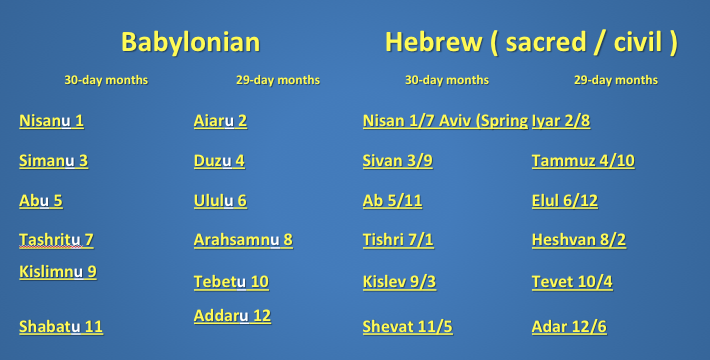
At first, the Jews used these Babylonian month names alongside the Torah month names, but over time the Torah month names fell into disuse.

As the Jewish People became more comfortable with the Babylonian month names, they became more susceptible to other Babylonian influences.
One field of Babylonian religious influence was in the observance of Yom Teruah as a New Year celebration.
From very early times the Babylonians had a lunar-solar calendar very similar to the biblical calendar. The result was that Yom Teruah often fell out on the same day as the Babylonian New Years festival of “Akitu”.

The Babylonian “Akitu” fell out on the 1st day of Tishrei which coincided with Yom Teruah on the 1st day of the biblical Seventh Month.
When Jews started calling the “Seventh Month” by the Babylonian name “Tishrei”, it paved the way for turning Yom Teruah into a “Jewish Akitu”.
The Rabbis, of course, did not want to adopt Akitu outright. Therefore, they added the name
Rosh Hashanah – (Head of the Year) to Yom Teruah, which eventually became the more common name for this holiday.
And now a little bit of Hebrew:

TE’RUAH – תרועה – blast (trumpet, shofar)
On Rosh Ha’Shanah this is the series of tremulous notes of the shofar.
In Modern Hebrew the verb להריע – LE’HARIA is used nowadays with the meaning of ‘to cheer’, ‘to applaud’.
The word שנה (shanah) – year also relates to the root
שנה
from which the word
שנוי – SHINUY
is derived.
It means – change / transformation.
And Rosh Hashanah (Head of The Year) could indeed be the starting point for anyone wishing to institute positive change or even a profound transformation in his/her life in the coming year.

Wishing you and your loved ones “SHANAH TOVAH”
שנה טובה
Shanah Tovah – A Happy New Hebrew Year

Yoel & Orly and all of us at Ulpan-Or
Many ask us for a permission to redistribute our newsletters – by all means, please do feel free to forward this newsletter to anyone you wish!
Subscribe to our newsletters on our website at the bottom of the home page:
www.ulpanor.com

Our archive of posts and newsletters may be found at:
https://www.ulpanor.com/category/newletter/