

Intellectual vs. Material Joy

Shalom,
Tomorrow night we will be celebrating the holiday of Simchat Torah – שמחת תורה.
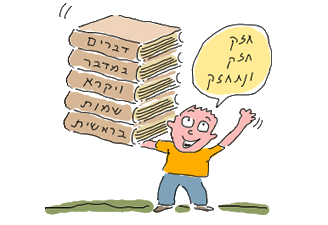
This is the day on which we end the current annual Torah reading cycle with the last Torah portion:
וזאת הברכה
and begin the next annual Torah reading cycle with the first Torah portion:
בראשית
We know that the holiday of Shavuot celebrates the receiving of the Torah.
Why then was Simchat Torah chosen as the day to end and begin the annual Torah reading cycle?
Furthermore, why Shavuot and Simchat Torah celebrated so differently?
On Shavuot, people stay up all night learning Torah, while on Simchat Torah, they dance.
There is parable – משל (attributed to the Maggid of Dubna) explaining the need for the two holidays related to the Torah.
The Parable – המשל
Once a king issued a proclamation. Any one of his subjects was welcome to try for the hand of his daughter.
On one condition: The potential suitor was not allowed to meet or see his daughter before the marriage.
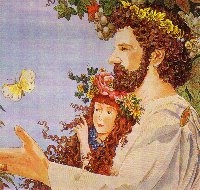
The proclamation caused quite a stir. Soon the local inns were buzzing with speculation and rumors.
“I hear she is a real shrew,” said one.
“I heard she is a deaf-mute,” said another.
“I know for a fact that she is a total imbecile,” intoned a third.
Round and round the rumors flew.
Finally, a simple wholehearted Jew spoke up.
“I am willing to marry her. How bad can she be? After all, she is the king’s daughter and we all know how great our king is.”
Word quickly spread and the suitor was led to the palace. As it turned out, he was the only one who volunteered. The king accepted the match and the wedding date was set.
After the wedding, the groom escorted his bride to their new home. She removed her heavy veil, and he was astounded at her beauty. Remembering the rumors of her reputed faults, the groom decided to thoroughly test her.
He engaged her in conversation, tested her in character and refinement and found himself pleasantly surprised. In every way, she excelled beyond his greatest hopes and dreams.
Overjoyed, he held a lavish party to celebrate his good fortune.

Explanation of the Parable
The King in the parable is the Creator.
When He wanted to give the Torah, He offered it to each nation in turn. All the nations refused, each one claiming some fault in the Torah they would not be able to live with.
When God offered it to the people of Israel, they said ‘Naaseh VeNishma’ – נעשה ונשמע “we will do, and then we will understand” (Exodus 24:7).
The people of Israel accepted the Torah without having seen it, as they were grateful for all G-d had done for them.
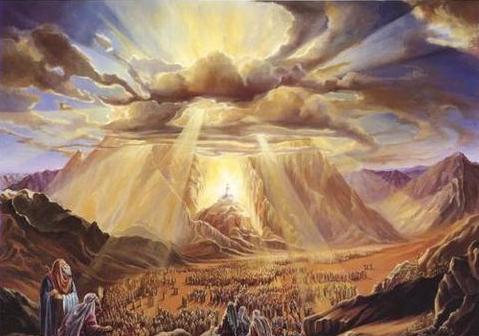
Though the people of Israel fully accepted the Torah, they feared a loss. They assumed that the numerous obligations in the Torah would deprive them of their pleasures and freedom.
Similarly, the groom in the parable married the king’s daughter fearing he would be disappointed in other areas.
But as the people of Israel learned the Torah and applied its teaching to their lives, they were pleasantly surprised. Not only did they not have to give up anything, they found the Torah maximized their pleasure in every way.
Therefore, at the conclusion of reading the Torah, when we have again delved into its teachings for a full year, we make a party on Simchat Torah.

On Shavuot, we stay up and learn all night to show our readiness and anticipation to receive the Torah.
Because it is an intellectual appreciation, we stay up all night learning Torah.
On Simchat Torah, however, we dance – expressing the emotional joy of the body.
We are showing that even our bodies have gained tremendously by keeping the Torah.

And as we start the annual Torah reading cycle, you are welcome to subscribe to our “B’Reshit” eBook at a very special monthly subscription price of only $4.99
This multimedia eBook presents the reader with fascinating insights, parables and commentaries associated with all the ten weekly Torah portions included in the book of Genesis.

Following is the link to this eBook.
https://gx210.infusionsoft.com/app/storeFront/showProductDetail?productId=1013
Wishing you a very happy Simchat Torah.
You can find our previous posts at:
https://www.ulpanor.com/category/newletter/