Skip to content
Whatsapp Phone-alt

We are live! Discover our updated Hebrew courses

  • Become a Partner
  • Login
Facebook X-twitter Youtube

Summer Sale · 20% off with code SUMMER20 →

  • Become a Partner
  • Login
  • Courses
    • All Courses
    • Private Online Mentorship
    • Live Online Groups
    • Hybrid Programs
  • Schools & Communities
  • Digital Products
    • E-Tone®
    • eBooks
  • Blog
  • Our Method
  • Courses
    • All Courses
    • Private Online Mentorship
    • Live Online Groups
    • Hybrid Programs
  • Schools & Communities
  • Digital Products
    • E-Tone®
    • eBooks
  • Blog
  • Our Method

Ulpan·Or

0.00 $ 0 Cart
0.00 $ 0 Cart
  • Courses
    • All Courses
    • Private Online Mentorship
    • Live Online Groups
    • Hybrid Programs
  • Schools & Communities
  • Digital Products
    • E-Tone®
    • eBooks
  • Blog
  • Our Method
  • Courses
    • All Courses
    • Private Online Mentorship
    • Live Online Groups
    • Hybrid Programs
  • Schools & Communities
  • Digital Products
    • E-Tone®
    • eBooks
  • Blog
  • Our Method

Ulpan·Or

  • Articles, Blog

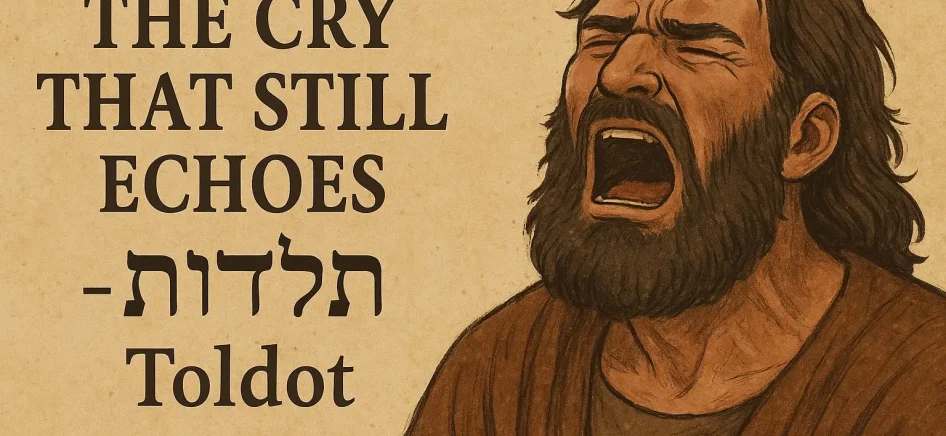
The Cry That Still Echoes

The Cry That Still Echoes
  • Yoel Ganor
  • November 21, 2025

Shalom from Yoel and Orly, founders

of Ulpan-Or, the International Center
for Hebrew and Israeli Culture Studies.


Hebrew at the Speed of Light!


“The Cry That Still Echoes – Torah Portion Toldot”


We usually meet Esav (עֵשָׂו / Esav) as the antagonist of the story. But the Torah reveals something surprising:


  • The first human shout in the Torah — “צעקה / tze’akah / a cry-out”
     
  • The second human weeping — “בכי / bechi / tears”—
both belong to Esav.


Classical Jewish teachings say that this cry was so powerful that its echo still shapes human history.


But the Jewish spiritual path is not to reject this energy —
it is to redeem it, elevate it, and aim it toward the right address:


 Esav — The First Cry in Human History


When Esav discovers that Yaakov received the blessing, the Torah states:


“וַיִּצְעַק צְעָקָה גְּדוֹלָה וּמָרָה עַד־מְאֹד”


“He cried out a great and very bitter cry.” (Genesis 27:34)

And:


“וַיִּשָּׂא עֵשָׂו קֹלוֹ וַיֵּבְךְּ”


“Esav raised his voice and wept.” (Genesis 27:38)


At first Yitzchak tells him:
“I have already blessed your brother — there is nothing left.”


But Esav refuses to accept this reality.
His shouting and crying pull down a new blessing that “did not exist” before.
 

Jewish commentary explains that much of the worldly success later seen in Edom (אֱדוֹם / Edom) — Esav’s descendants — is attributed to:

·        כיבוד אב / kibbud av / honoring one’s father

·        צעקה / tze’akah / a cry-out from the depths of the heart


To this day, we live in a world where Esav’s cry is still felt.


Where Is God in a Cry? 


Jewish mysticism teaches two foundational principles:

·        “הצמצום אינו כפשוטו / ha-tzimtzum eino ke-feshuto / the divine ‘contraction’ is not literal”

·        “לית אתר פנוי מיניה / leit atar panui minei / no place is empty of God”


Meaning:

·        God is present in our actions, our prayers, and our goodness.

·        He is also present inside our pain, our confusion, and our cries.


The Sages teach:


“גדולה צעקה… שקורעת גזר דין”


“Great is the cry — for it can tear up a harsh decree.”


Even when things feel impossible, tradition whispers:

“You still have somewhere to go: cry out to God.”


“Their heart cried out to God.” (Lamentations 2:18)

The deepest cry is often silent.


 Where Not to Shout — And Where We Must


Where NOT to direct this power:
 

·        toward children

·        toward a spouse

·        toward strangers

·        toward the world in anger

That is the “Esav-side” of shouting.


Where SHOULD we direct it?


• תפילה / tefillah / prayer

“God, I can’t continue like this. Help me.”

• Learning and clarity

“Show me what You want from me. Open my understanding.”

• Love and joy

Moments too big for the heart to contain — at a wedding, a birth, or a breakthrough.


Same energy – Elevated.
 

Esav’s Tears vs. Jewish Tears


Rabbi Nachman of Breslov teaches:

·        Esav cried for lost privilege.

·        A Jew cries from longing for closeness to God.

Rabbi Natan explains that בכי / bechi / tears are really רצון / ratzon / deep desire.

Thus:

·        Esav’s crying = “You didn’t give me what I want.”

·        Jewish crying = “I want You.”

When our tears come from yearning, we uproot Esav’s ancient cry at its source.


(Based on R. Vered’s lesson) 


 Modern Psychology on Crying


Modern psychology views crying not as a weakness but as a profound form of emotional truth-telling.


Dr. Judith Orloff, a psychiatrist who writes extensively on emotional health, explains that tears are the body’s way of releasing what the mind can no longer hold alone—a biological reset button that lowers stress hormones and restores a sense of inner balance.


Similarly, researcher Dr. Ad Vingerhoets, one of the world’s leading experts on crying, notes that tears serve as a signal of authenticity and vulnerability, helping us connect more deeply with others and with ourselves.


In this view, a cry is not merely an emotional overflow; it is a moment when the heart speaks the truth the mind has been whispering.


A Simple Story: “Abba! Don’t Leave Me!”


Imagine praying in a synagogue.
 
Next door is a preschool on the first day of school.

A child screams:

“Abba! Abba! Don’t leave me! Come back!”


At first it distracts you. Then it dawns on you:


This is exactly what prayer is. We are all children calling:
“God, don’t leave me. Come back for me.”

And suddenly your whisper “Abba…” becomes a real cry.


·        צעקה / tze’akah — cry-out from the depths

·        בכי / bechi — a cry


Modern Hebrew expression:


לא בוכים על חלב שנשפך-
 
lo bokhim al khalav shenishpakh

Don’t cry over spilled milk


As we read about Esav’s ancient cry in Parashat Toldot, we cannot ignore the cries rising today from Israel (יִשְׂרָאֵל / Yisrael) — families waiting for missing loved ones, soldiers in danger, communities rebuilding shattered homes, and a nation struggling with uncertainty yet clinging to hope.


Jewish tradition teaches that צעקה / tze’akah / a heartfelt cry can open spiritual gates even when all seems blocked. In this moment of national pain and longing, every tear, every whispered “ה’ / Hashem / God, help us,” and every act of unity becomes part of a collective cry that lifts all of us.


May our personal and national tze’akah draw healing, protection, strength, and גאולה / ge’ulah / redemption for the people of Israel — speedily, gently, and in peace.


Shabbat Shalom,
 
Yoel & Orly 

Now listen to a beautiful Israeli song
“Tears of Angels” 


https://www.youtube.com/watch?v=ozySUaQao3Y&list=RDozySUaQao3Y&start_radio=1

Lyrics


Tears of angels.

Quiet tears,
beautiful and sad tears.
Tears sliding across the horizon, searching…
What are they seeking? Ah…


For when the angels weep
in another world,
then in this world
our sadness deepens.


Tears of angels.
Why do the angels weep?
Perhaps because it isn’t easy
to be an angel
in a world so full of sorrow.


For when the angels weep…

And we here, too,
wish to cry—cry with them.
What can we do?
We want to cry, yet the tears won’t fall,
the tears simply won’t fall


Many ask us to redistribute our newsletters regarding Hebrew language learning and Hebrew insights.


By all means, please do feel free to forward this newsletter to anyone you wish! 

More from the blog

Pesach Night of Seder: The Ladder of Freedom

Read more →
  • March 26, 2026

The Extraordinary Hebrew Journey of Barbara Crook

In the landscape of people who learned Hebrew Language Online, one name rises above all others: Barbara Crook. Her story is not merely about mastering a new language. It is
Read more →
  • March 25, 2026

A Journey for Brain, Memory and Soul

In today’s world of constant noise, uncertainty, and rapid change, it’s easy to feel mentally overwhelmed and spiritually unanchored. Many people search for ways to keep their brain strong, their
Read more →
  • March 25, 2026

When Good Intentions Are Not Enough

Read more →
  • March 19, 2026

Building a Sanctuary in a Time of Sirens

Read more →
  • March 13, 2026

Broken Tablets, Unbroken Covenant

Read more →
  • March 6, 2026

Join the Ulpan-Or Family

Get the latest Hebrew learning tips, stories,
and exclusive offers — straight to your inbox.

Don’t Just Learn Hebrew. Speak It. Master real, everyday Hebrew with our revolutionary RLA method.

  • Courses
    • All Courses
    • Private Online Mentorship
    • Live Online Groups
    • Hybrid Programs
  • Schools & Communities
  • Digital Products
    • E-Tone®
    • eBooks
  • Blog
  • Our Method
  • Courses
    • All Courses
    • Private Online Mentorship
    • Live Online Groups
    • Hybrid Programs
  • Schools & Communities
  • Digital Products
    • E-Tone®
    • eBooks
  • Blog
  • Our Method
  • WhatsApp: (+972) 55-982-8312
  • USA Phone: (+1) 646-217-4866
  • Email: office@ulpanor.org
  • Become a Teacher
Facebook Twitter Youtube

Don’t Just Learn Hebrew. Speak It. Master real, everyday Hebrew with our revolutionary RLA method.

Youtube Facebook Instagram Spotify

Explore

  • Home
  • About Us
  • Shop
  • Blog
  • Contact Us

Learn With Us

  • Private Online Mentorship
  • Live Online Groups
  • Hybrid Programs
  • E-Tone®
  • eBooks

Get in Touch

  • WhatsApp: (+972) 55-982-8312
  • USA Phone: (+1) 646-217-4866
  • Email: office@ulpanor.org
  • Become a Partner

Legal & Privacy

  • Terms and Conditions
  • Privacy Policy
  • Accessibility Statement
  • Cookie Policy

Join the Ulpan-Or Family

Subscribe to get the latest Hebrew learning tips and exclusive offers delivered to your inbox.

Copyright: © 2026 Ulpan-Or. All rights reserved