When a Word Arrives Before
News

Shalom from Yoel and Orly, founders
of Ulpan-Or, the International Center
for Hebrew and Israeli Culture Studies.
Hebrew at the Speed of Light!
You’re invited to a personalized conversation with Ulpan-Or’s founders—an opportunity to map out the Hebrew journey that fits you best.
Secure your place on Zoom HERE
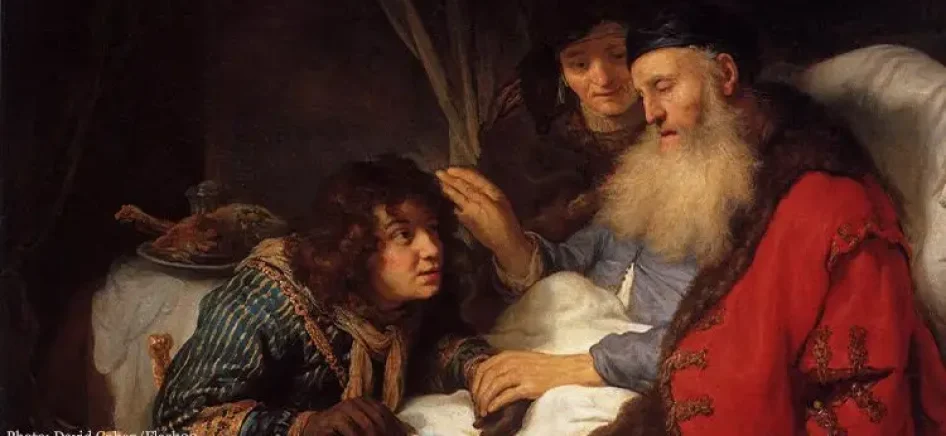
We are closing the book of Bereshit with Torah portion Vayechi — a parashah that feels like the final knot being tied.
Not just the end of a book, but the end of a long family storm:
- Jealousy.
- Betrayal.
- Twenty-two years of grief.
- And then—revelation, forgiveness, and life.
But the most fragile moment of the entire story isn’t Joseph standing before his brothers.
It’s Jacob hearing the impossible sentence:
“Joseph is alive.”
Because for Jacob, Joseph wasn’t merely “gone.”
He was torn away, with no grave, no closure, no goodbye.
And Jacob carried that pain for 22 years.
So how do you deliver the truth without breaking the heart that has already broken?
Serach bat Asher: The Woman Who Delivered a Miracle — Softly
The brothers understood something incredibly human:
Sometimes the truth must enter the soul before it enters the mind.
So they asked Serach bat Asher, known for her musical gift, to do something unusual.
She approached Jacob while he was immersed in prayer and Torah.
She played a gentle melody—one that would not shock him, but prepare him.
And she sang:
עוֹד יוֹסֵף חַי
Od Yosef chai — “Joseph is still alive.”
Jacob didn’t understand. It sounded strange, even absurd.
But the words slipped into him like light through a crack.
And only then—after the heart had a place to breathe—
the brothers came in and revealed the full truth.
The Blessing: A Mouth That Spoke Life
Jacob calls Serach and blesses her with a blessing that sounds almost mythic:
The mouth that said “chai” — life — will never taste death.
Serach becomes, in the language of our sages, האישה הנאמנת (ha-ishah ha-ne’emanah — the faithful woman).
She appears again later as the keeper of memory, the guardian of redemption:
She is the one who remembers where Joseph’s coffin was hidden in the Nile. Without her, Moshe cannot fulfill Joseph’s oath, and the Exodus stalls.

And then, astonishingly, she appears centuries later again — a living witness to Kriyat Yam Suf.
A single person carrying a nation’s memory.
A single voice carrying the word “chai.”
A Chassidic Story: The Rebbe’s Whisper
A chassid once came to his Rebbe crushed by despair.
He had lost something precious—maybe a relationship, maybe a dream, maybe faith itself.
He said: “Rebbe, it’s over.”
The Rebbe didn’t argue. He didn’t preach.
He simply asked the chassid to come close—and whispered just two words:
עוֹד… חַי.
Od… chai.
“Still… alive.”
The chassid looked confused. “Alive? What’s alive?”
The Rebbe answered:
“Hope is alive. Your נשמה (neshamah—soul) is alive.
The future you can’t yet see—is alive.
But if I shout it at you, you’ll reject it.
So I place it gently inside you—like a melody.”
That’s the Chassidic wisdom:
Sometimes the biggest redemption begins not with thunder, but with a quiet sentence you carry home.
Hebrew Corner — Words That Carry Generations
1) עוֹד יוֹסֵף חַי
Hebrew: עוֹד יוֹסֵף חַי
Transliteration: Od Yosef chai
Meaning: “Joseph is still alive.”
Modern Hebrew usage
עוֹד X חַי (Od X chai) = “X is still alive” — but it’s also used emotionally:
“This idea is alive.” “This hope is alive.” “This connection is alive.”
And, of course – AM ISRAEL CHAI – “The Nation of Israel Lives On.”
2) וַיְחִי
Hebrew: וַיְחִי
Transliteration: Vayechi
Meaning: “And he lived.”
Modern Hebrew usage:
The root ח־י־ה (to live) shows up everywhere:
חַיִּים (chayim) = life לְהַחֲיוֹת (le’hachayot) = to revive / bring back to life מְחַיֶּה (mechayeh) = “reviving,” also slang: A’mechayeh “That’s so refreshing!”
לְחַיִּים (L’Chaim) – is a common Hebrew expression that literally means “to life”.
3) לְבַשֵּׂר — “to bring news”
Hebrew: לְבַשֵּׂר
Transliteration: le’vaser
Meaning: “to announce / to bring good news.”
Modern Hebrew usage:
בְּשׂוֹרוֹת טוֹבוֹת (besorot tovot) = “good news”
A Modern Lens: Why Jacob Needed a Melody, Not a Headline
Modern psychology helps us understand something the Torah already knew thousands of years ago.
Trauma Cannot Absorb Sudden Truth
Contemporary trauma research — from thinkers like Bessel van der Kolk, author of The Body Keeps the Score — explains that when a person carries long-term grief, the nervous system resists sudden emotional reversals.
In simple terms:
A traumatized heart cannot jump instantly from despair to joy.
That’s why shocking “good news” can be dangerous.
The body doesn’t process it as relief — it experiences it as threat.
Jacob didn’t just believe Joseph was dead.
His entire nervous system had reorganized around that loss.
Why Music Works Where Words Fail
Neuroscience tells us that music bypasses the rational brain and speaks directly to emotional memory.
Music:
- Lowers resistance
- Softens defensive reactions
- Creates safety before meaning
That’s exactly what Serach bat Asher did.
She didn’t announce.
She didn’t explain.
She didn’t argue.
She regulated Jacob’s soul first — and only then allowed truth to enter.
Modern therapists call this titration: introducing truth in small, safe doses.
The Torah calls it wisdom.
We live in an age of alerts, headlines, breaking news, and emotional overload.
We think truth must be fast.
The Torah insists truth must be wise.
Serach bat Asher teaches us:
- Not every truth should arrive as a notification
- Not every healing begins with facts
- Sometimes redemption enters as a melody, not a message
Just as Jacob was granted 17 years of life —
the numeric score of טוב is 17
(tov — goodness) after decades of pain,
May we too merit:
- healing without shock
- truth without cruelty
- hope that strengthens rather than breaks
And may we soon hear the final, gentle sound —
the melody of of the Final Redemption
bringing joy not as an explosion,
but as a deep, steady breath of relief.
Shabbat Shalom,
Yoel & Orly